Japan
Acting to support the government of Japan, International Medical Corps continues to ramp up relief and recovery efforts to assist residents affected by Typhoon Hagibis, one of the strongest storms to hit the country in the past decade. More than 70 died after the storm dumped more than 3 feet of rain within a 24-hour period in October 2019 on areas southwest of Tokyo.
Approximately 4,000 people were displaced from their homes, taking shelter in evacuation centers, while about 50,000 homes were affected by flooding. Water-supply issues, power outages and additional flooding affected facilities for the elderly as well as for childcare centers. Chiba, Fukushima, Ibaragi, Nagano, Miyagi, Tochigi, Tokyo and Saitama were the hardest-hit prefectures.
Our teams coordinated with local organizations to provide relief supplies and address longer-term needs, helping communities recover and strengthen their own response capabilities.
Our response to Typhoon Hagibis marks the second time in 15 months that we have responded to support those in Japan affected by major flooding. In July 2018, we reached 1,000 people with relief and recovery services after areas of western Japan endured some of the worst flooding in nearly four decades. The disaster damaged or destroyed some 9,500 private dwellings,and more than 22,000 people were hospitalized as temperatures soared in the midsummer heat. International Medical Corps was one of the first responders to reach Ehime prefecture in southwestern Japan, where our team addressed unmet needs of the aged, as well as children, displaced from their homes.
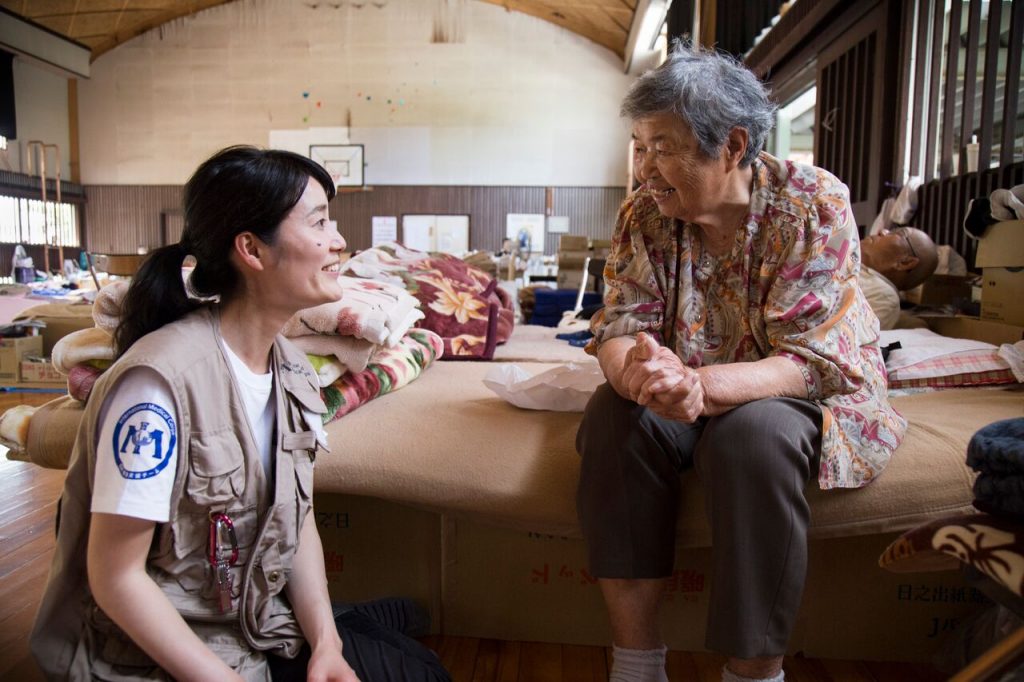
In April 2016, we responded to two earthquakes that rocked Kumamoto prefecture on Kyushu, the country’s third-largest island, located southwest of Japan’s main island of Honshu. The two earthquakes together killed 49 people, injured 1,400 and forced 181,000 people to evacuate their homes. Many moved into evacuation centers set up in schools, community centers and other available buildings. Together with local authorities and organizations, International Medical Corps responded to the needs of those displaced by the twin earthquakes, reaching approximately 2,500 people with relief and recovery efforts across 20 evacuation centers.
Our initial response in Japan came in 2011, after the catastrophic 9.0-magnitude earthquake, tsunami and subsequent Fukushima nuclear crisis in March of that year. International Medical Corps’ emergency response team was on the ground 48 hours after the disaster struck, working to support the government and local partner organizations in efforts to help communities affected by the disaster.
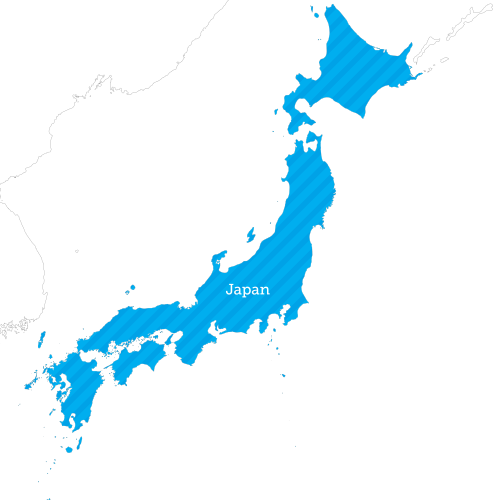
127.1 million
84 years
46.1 Years
Our Response
Today, International Medical Corps continues to collaborate with local organizations that provide for the immediate needs of families and individuals following natural disasters. In addition to providing direct services, we help to build the capacity of local response organizations so they are better able to respond to a future crisis.
Our Impact
Japan After the Earthquakes
Kumamoto, Japan—Kuramoto Shieko, 85, was in the bath when the ground beneath her began to violently shake, rattling the frame of her house. She and her husband rushed outside as quickly as they could. It would be Kuramoto’s last time in her home, which her father had carefully built more than 130 years ago.
READ MORE