
Sudan
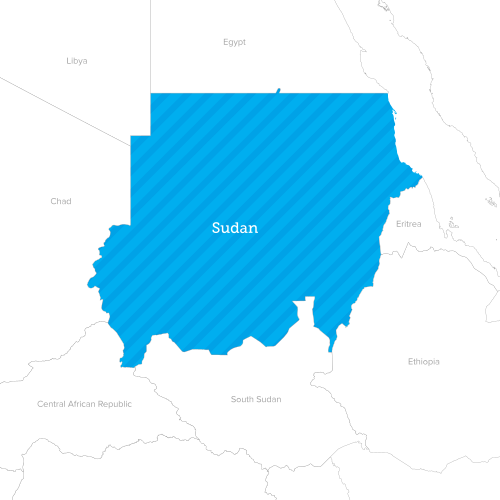
International Medical Corps has worked in Sudan since 2004. We offer healthcare, mental health and psychosocial support (MHPSS), nutrition, services related to violence against women and girls (VAWG), and water, sanitation and hygiene (WASH) programs, often integrating them to achieve more effective outcomes. We provide these services through static health facilities mobile health and nutrition teams (MHNTs), and women’s and girls’ safe spaces in Central Darfur, North Darfur, South Darfur and Khartoum.
Once the largest and most geographically diverse nation in Africa, Sudan split into two separate countries in July 2011, after the people of what is now South Sudan voted for independence. Today, Sudan is experiencing significant turmoil, and is the largest humanitarian crisis in the world. The crisis is compounded by annual outbreaks of disease, including dengue fever, cholera and malaria. Despite limited access and chronic instability, in 2025, we provided humanitarian assistance to more than 1.8 million people in Sudan.
50 million
66/69 years
male/female
19.6 years
The Challenges
Health System
Approximately 37% of health facilities are currently nonfunctional.

Inadequate Water
17.3 million people lack access to basic drinking water.

Poor Nutrition
An estimated 21.1 million people are experiencing severe food insecurity.
Our Response
Healthcare
International Medical Corps currently supports 10 health facilities, six mobile health and nutrition teams and three stabilization centers across Sudan, delivering essential health services, strengthening health systems and providing resources to deploy skilled health workers. Essential health services include treatment and prevention of disease, maternal and newborn health, health education, immunization, child healthcare and surveillance, and referrals to emergency- and secondary-level healthcare services. Maternal and newborn health services include prenatal care, safe deliveries attended by skilled birth attendants, postnatal and newborn care and healthy timing and spacing of pregnancies to reduce maternal and newborn mortality. We also provide care for survivors of VAWG and safe referrals for survivors. In 2025, we provided nearly 1 million outpatient consultations, including treating patients for acute respiratory infections, diarrheal diseases and malaria, which continue to be the leading causes of disease in Sudan. We also immunized hundreds of thousands of children, and 14,518 babies were delivered by skilled healthcare personnel.
Health Systems Strengthening
International Medical Corps works closely with health authorities, local organizations and community stakeholders to strengthen health systems and improve the quality and availability of healthcare services. We support Sudan’s Ministry of Health (MoH) in providing healthcare services. Our activities include supporting service delivery, health facility rehabilitation, enhancing health information and reporting systems, deploying healthcare workers, training, and providing medical commodities and emergency preparedness, contingency planning and response.

Nutrition
International Medical Corps provides nutrition services for those most vulnerable to malnutrition, including children under 5, pregnant women and nursing mothers. We operate outpatient therapeutic programs (OTPs), targeted supplementary feeding programs (TSFPs) and stabilization centers for malnourished children with medical complications. We provide nutrition awareness sessions for mothers on different topics such as the importance of breastfeeding, dietary diversification using local foods and targeted nutritional support. In 2025, we reached hundreds of thousands of people through vital nutrition programs, including providing 128,445 caregivers of children under 2 with essential infant and young-child feeding counseling and support.

Water, Sanitation and Hygiene (WASH)
Many communities in Sudan experience sub-standard water quality and insufficient quantity—17.3 million people lack access to basic drinking water, while about 24 million lack access to proper sanitation facilities. Influxes of refugees and internally displaced persons (IDPs) frequently strain host communities and camp water-collection and sanitation systems. By expanding access to clean water, creating proper waste-disposal systems and providing safe sanitation facilities, we restore and protect healthy living conditions.
In Sudan, we implement WASH activities as part of health, nutrition and protection interventions, including:
-
- promoting good hygiene practices;
- creating waste disposal facilities and safe practices;
- chlorinating, rehabilitating and maintaining water points;
- constructing and rehabilitating drainage canals and latrines; and
- improving WASH and infection prevention and control in health facilities.
In 2025, we constructed or rehabilitated 17 water points for internally displaced people and host communities, and reached nearly half a million people with information about the need for safe hygiene practices and other WASH activities.

Mental Health and Psychosocial Support
The ongoing conflict has exposed millions of people to violence, displacement, loss and psychological distress. International Medical Corps provides MHPSS services through an integrated, multisectoral approach, embedding MHPSS within health programs while ensuring strong linkages with nutrition, protection, VAWG and community-based services. Our MHPSS program aims to improve mental health, enhance resilience and well-being, build social support networks and empower affected populations, including children and youth. Our MHPSS services include psychological support, mental health case management, psychological first aid (PFA) and group psychosocial support (PSS). Community-based PSS activities include community outreach, mental health awareness and psychoeducation. International Medical Corps also provides training for key stakeholders, including general health providers, MHPSS staff, community leaders, local partners and staff from other humanitarian agencies. In 2025, we provided mental health consultations to 6,308 people, and 25,541 people participated in psychosocial support activities.

Violence Against Women and Girls
To address rising protection needs, we launched a VAWG program in 2024, working with local and women-led organizations to provide survivor-centered services, including case management, psychosocial support and referrals. We integrate VAWG with health, nutrition and MHPSS programming, strengthen referral pathways, engage communities to address harmful norms, and support coordination and capacity building.
Capacity Building
Overall, the health system’s limited capacity and response mechanisms have severely weakened the ability to provide adequate healthcare. Since arriving in Sudan in 2004, we have trained thousands of local and national medical personnel, including traditional birth attendants and community leaders, in collaboration with the MoH. In 2025, we trained 1,519 MoH staff in emergency obstetric and newborn care, rational drug use, intimate partner violence response, integrated management of childhood illnesses, malnutrition management, infant and young child feeding, outbreak preparedness, infection prevention and control, MHPSS, safe referrals, data management and VAWG case management. Localization remains central to our approach, supporting local leadership and helping to build sustainable, lasting change.
Our Impact in 2025
Medical Teams Bring Healing to the Front Lines in Darfur
As fighting devastates Sudan, displacing millions, International Medical Corps is providing critical medical care, including lifesaving surgeries, safe deliveries and mental health services.
READ MORE


Women and their children wait outside the Karkoj Health Center in Singa.
International Medical Corps’s mobile health and nutrition team evaluates whether a child is malnourished at the Souk Al Kadar camp.
A child sits with stuffed animals and toys after receiving health treatment at Geissan Hospital.
A mother and her three children wait to be evaluated for nutrition services after they were displaced by the ongoing conflict.
An International Medical Corps team member examines a patient at a mobile medical clinic in Sudan.
Community member Hassan (left) and his family sit together in Umdukhun Hospital, where his young son received treatment for measles.
Frequently Asked Questions
-
What is the humanitarian crisis in Sudan?
Sudan is experiencing the world’s largest displacement crisis, with conflict, food insecurity, outbreaks of infectious disease and the destruction of essential infrastructure driving severe humanitarian needs across the country. Communities continue to face major barriers to healthcare, food, safe water and sanitation, while disrupted supply chains and funding constraints make it increasingly difficult for humanitarian organizations to reach people in need. Women and girls face heightened risks of violence and other protection concerns, particularly in conflict-affected and displacement settings.
-
When did the Sudan conflict start?
In April 2023, clashes erupted between the Sudanese Armed Forces and the paramilitary Rapid Support Forces in Khartoum, Sudan’s capital, and quickly spread to other areas, with air strikes and street fighting in cities. Violence has since spread across much of the country, driving mass displacement, widespread destruction and the collapse of essential services in many areas, particularly in Darfur and Kordofan. More than three years later, fighting and insecurity continue to restrict humanitarian access and limit people’s access to healthcare, food, water, sanitation and protection services.
-
What is the state of healthcare in Sudan?
Sudan’s healthcare system is in crisis. Approximately 37% of health facilities have closed or are unable to provide services. The situation is substantially worse in some conflict-affected areas, where facilities have been damaged, destroyed, looted or forced to close. Disease outbreaks, malnutrition, shortages of medicines and medical supplies, attacks on healthcare, displacement of health workers and limited funding continue to place enormous pressure on the health system. Millions of people lack reliable access to essential healthcare, while humanitarian organizations and Sudanese health authorities are working to maintain and restore services wherever access is possible.
-
How many people need humanitarian assistance in Sudan?
An estimated 33.7 million people in Sudan require humanitarian assistance. Sudan also faces an unprecedented displacement crisis. According to the World Health Organization, approximately 13.6 million people have been displaced inside Sudan, and more than 3.2 million people have fled to neighboring countries. Displacement figures continue to change as people are forced to flee, return or become displaced again, making it one of the largest displacement crises in the world.
-
How is International Medical Corps helping in Sudan?
International Medical Corps has worked in Sudan since 2004 and continues to provide lifesaving humanitarian assistance in some of the country’s most conflict-affected and hard-to-reach communities. Our programs include primary and secondary healthcare, maternal and newborn health, child health, nutrition, mental health and psychosocial support (MHPSS), services related to violence against women and girls (VAWG) and water, sanitation and hygiene (WASH). We also strengthen local health systems by training and mentoring healthcare workers, supporting disease surveillance and outbreak preparedness, and providing essential medicines, medical supplies and other resources.
International Medical Corps currently works through supported health facilities, mobile health and nutrition teams, stabilization centers and women’s and girls’ safe spaces in parts of Darfur and Khartoum, adapting operations as security, access and humanitarian needs evolve. In 2025, International Medical Corps provided humanitarian assistance to more than 1.8 million people in Sudan.
Our teams continue to work with Sudan’s Ministry of Health and other partners to maintain essential services, strengthen frontline health workers and respond to outbreaks and other public health emergencies.
-
Where does International Medical Corps work in Sudan?
International Medical Corps provides humanitarian services in several regions, including Central Darfur, North Darfur, South Darfur and Khartoum. Our geographic footprint and supported facilities change over time in response to security conditions, humanitarian needs, funding and access.
-
How can I help people in Sudan?
Humanitarian needs in Sudan remain immense and continued support is critical. By donating to International Medical Corps, you can help people in Sudan—including pregnant women, children and families displaced by conflict—access lifesaving healthcare and other essential services. Your donation will help us save lives in Sudan and respond to other crises worldwide.