Nutrition
Nutrition & Food Security
Nutrition: The Pivotal Ingredient to Good Health
Nutrition is pivotal, especially during a child’s first 1,000 days (from conception to the age of 2). Suboptimal nutrition during this window of opportunity deprives a child of reaching his or her full potential and can impair physical and cognitive development.
Increased nutrition-related morbidity and mortality, the added risk of developing noncommunicable diseases later in life, and reduced IQ and school performance can all be attributed to malnutrition. In addition, malnutrition during childhood can impact future generations—for example, when malnourished adolescent girls have sub-optimal nutrition during pregnancy, it can lead to low birthweight babies, who in turn may experience malnutrition during childhood. It is therefore essential to break this intergenerational cycle of malnutrition with appropriate nutrition and food-security interventions.
Nutrition in Emergencies
The number of people forced to flee their homes globally because of armed conflict or persecution hit a record high of 123.2 million people—one in 67 people worldwide—in 2024. In the majority of such emergencies, people often experience both long- and short-term challenges with dietary intake—as well as with access to healthcare and safe water, sanitation and hygiene (WASH)—which can lead to malnutrition. Common forms of malnutrition in emergencies are acute malnutrition, micronutrient deficiencies and—if the crisis is prolonged—stunting. Practices surrounding maternal, infant and young-child nutrition can also deteriorate. Because of this, both treatment and prevention are essential aspects of nutrition response in emergencies.
About 45 million children under 5 worldwide are acutely malnourished. Treatment of acute malnutrition is the most cost-effective nutrition intervention to prevent child mortality, with the potential to save more than 713,000 lives annually.
Preventing malnutrition during emergencies is crucial to reducing the risk of nutrition-related morbidity and mortality. Preventive measures include support for infant and young-child feeding (IYCF) practices, such as early initiation of breastfeeding (within one hour after delivery), exclusive breastfeeding for the first six months and appropriate complementary feeding for children ages 6–23 months. Children who do not receive exclusive breastfeeding up to six months are 14% more likely to die than those who do. Exclusive breastfeeding also reduces episodes of child diarrhea by nearly half. IYCF activities can be implemented at a health facility through both individual and group counseling, and linked with community-based management of acute malnutrition (CMAM). At the community level, these activities can also occur through the care-group model, mother-to-mother groups and the men-as-partners approach.
Treatment of acute malnutrition, in both its moderate acute and severe acute forms, is critical in emergencies, when adequate nutrition is so often a challenge. We provide nutrition services for the most vulnerable groups, including acutely malnourished children ages 6–59 months, pregnant and breastfeeding women, and at-risk infants and their caregivers. Acutely malnourished children without complications receive ready-to-use supplementary or therapeutic foods and routine medications, such as antibiotics, at outpatient facilities, where they receive medical care and continuous monitoring. We admit children with acute malnutrition with medical complications to inpatient facilities, where they receive specialized medical and nutritional treatment. To ensure positive outcomes, caregivers and infants at high nutritional risk—including those born prematurely and those with growth failure or feeding difficulties—receive tailored nutritional, medical and mental health support.
Community mobilization and sensitization are both key preventive and curative strategies. They are essential to creating awareness among community residents about available nutrition services, to monitoring children and pregnant or lactating women and referring them to the nutrition services if necessary, and to conducting tracing for those children who have defaulted in the CMAM program. Community sensitization also involves social behavior change, which is tightly linked to IYCF, WASH, health and other areas. This makes cooperation with other technical sectors crucial to achieving maximum impact when nutrition programs are part of emergency interventions.
Nutrition Research at International Medical Corps
International Medical Corps’ nutrition research expands global knowledge of how to improve nutrition programs across humanitarian and development settings. Our research topics include testing new technologies to detect malnutrition; investigating risk factors for relapse in the treatment of malnutrition; investigating the causes of malnutrition and its effects; analyzing evidence on the effects of malnutrition on other health outcomes; and barrier-analysis studies.
For example, in Afghanistan we are investigating the overall and relative effectiveness of reduced dosages of ready-to-use therapeutic food for the treatment of uncomplicated severe wasting, and in Somalia, we assessed through two approaches—facility-based treatment and community-level care with integrated community case management—the effectiveness of treatment outcomes for children with severe wasting. The results of our studies contribute to the global evidence base and help to inform national and global policies, guidelines and strategies.
Global Nutrition Cluster Operations Team
International Medical Corps is a member of the Global Nutrition Cluster (GNC) Operations Team, providing both virtual and in-country support to country nutrition partners. We provide support in acute and protracted nutrition emergencies, and conduct preparedness work. International Medical Corps is a technical lead agency in CMAM and infant and young-child feeding in emergencies (IYCF-E).
In addition, International Medical Corps is a member of the GNC Strategic Advisory Group, co-leads several global technical working groups and co-leads country nutrition cluster technical working groups in a number of countries.
We provided more than 3 million people with nutrition services in 2025.
In 2025, we screened nearly 4.3 million children between the ages of 6-59 months for malnutrition.
More than 1 million caregivers received IYCF counseling; 400,000 received individualized sessions.
Our Response
International Medical Corps has a strong history of responding to nutrition needs in emergencies, starting with the 1992 famine in Somalia. Our malnutrition treatment evolved from a strictly center-based approach in the 1990s to a community-based approach using the best-practice aspects of the CMAM model to manage moderate and severe acute malnutrition.
International Medical Corps’ nutrition strategy contains four components that anchor our work.
- Standards and approaches. We prioritize strict adherence to minimum standards, to assure high-quality programming. Our work involves setting end goals to determine what conditions must change to reach those goals—a technique known as the theory of change.
- Evidence-based best practices. All programs and initiatives we implement are evidence-based, using either design findings from the global nutrition sector or evidence generated from our own research, to address needs and capitalize on existing resources and national protocols. We create and apply current best practices, including innovative approaches, wherever possible.
- Global knowledge management and transfer. We document and disseminate the results of our work and programmatic learning through global communities of practice, such as the Emergency Nutrition Network and the Global Nutrition Cluster.
- Strengthening capacity. This component is conducted both individually and organizationally through formal training, learning exchanges (such as digital platforms) and field exchange visits. We also work to build the capacity of ministries of health, local partners and local communities.
International Medical Corps implements our nutrition programs globally. Long-term development and emergency programs focus primarily on preventing all forms of malnutrition while treating those who are already malnourished. We are a recognized leader in emergency nutrition programs, providing services in multiple countries and territories on three continents.
International Medical Corps’ malnutrition prevention programs focus on the period from conception through the 23rd month of a child’s life—the “1,000-day window of opportunity”—as a critical time for preventing stunting and the physical and mental disabilities associated with malnutrition. We provide a combination of growth monitoring, nutrition education (including individual counseling), the use of micronutrient supplements distributed through health facilities and, as part of our ante- and postnatal care, infant checkups and community outreach. Our nutrition education and counseling promote healthy pregnancies and IYCF practices to ensure growth during the fetal stage, during infancy and during early childhood.
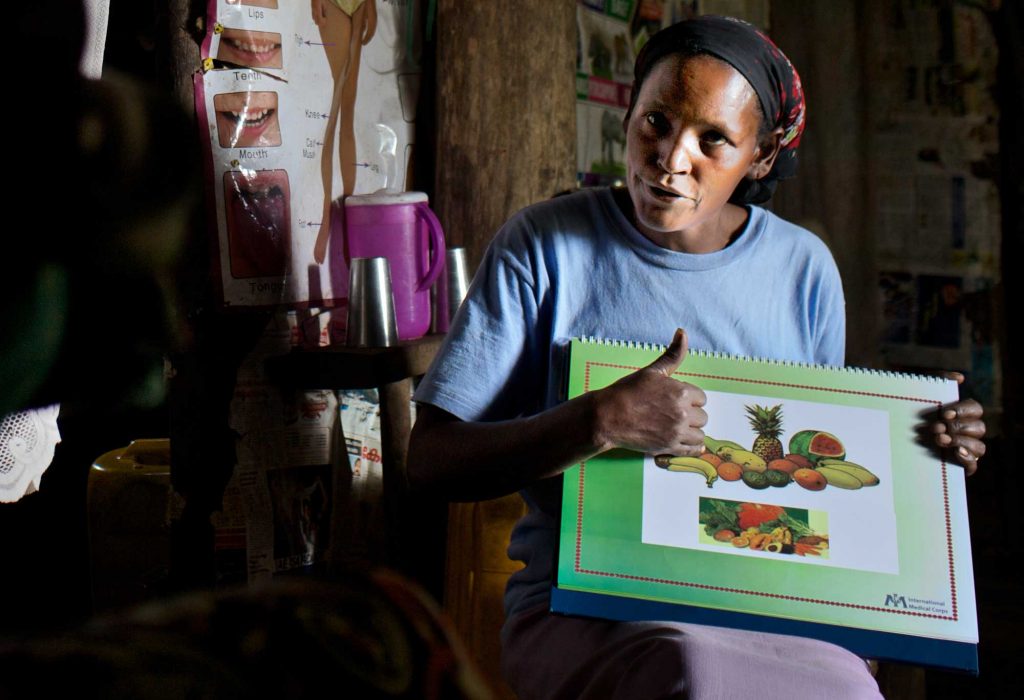
To reinforce nutrition messages and create behavior change within the community, International Medical Corps works with local residents to develop peer-support groups, including mother-to-mother groups and the men-as-partners approach. Care groups are led by local female volunteers trained by International Medical Corps who meet on a regular basis with mothers and their young children. The goals of these community-based behavior change interventions are to:
- prevent malnutrition by disseminating nutrition, health and hygiene information;
- improve mother/child interaction through methods like early childhood development; and
- enable mothers, fathers and communities to take responsibility for the growth and development of their children.
Mother-care groups improve behavior change, reduce costs and build a sustainable community-level health and nutrition promotion structure. Health and nutritional improvement cannot be ensured unless communities are aware of and utilize available health services. In addition, because most of the decisionmaking regarding critical influential behaviors occurs in the home, International Medical Corps works with households and individuals, as well as health facilities and community leaders, to bring about positive and lasting changes in attitudes, knowledge and behaviors.