Water
Water, Sanitation & Hygiene
International Medical Corps works to provide adequate, safe, potable water for drinking and personal and domestic hygiene at community and institutional facilities to people in emergency and development contexts.
Access to safe water is an essential component in the fight to reduce disease, whether it is diarrhea, pneumonia, eye and skin infections, malaria, cholera or typhoid. Improved access to safe water can reduce diarrheal disease rates by up to 25%. Yet 2.2 billion people worldwide still lack access to safe drinking water.
Larger volumes of water are also essential to maintaining infection-free environments in healthcare facilities that care for patients with highly communicable and contagious illnesses, such as Ebola.
Our Response
International Medical Corps operates WASH programs in some of the world’s most difficult and dangerous environments to provide lifesaving water to those in great need. These programs include the following.
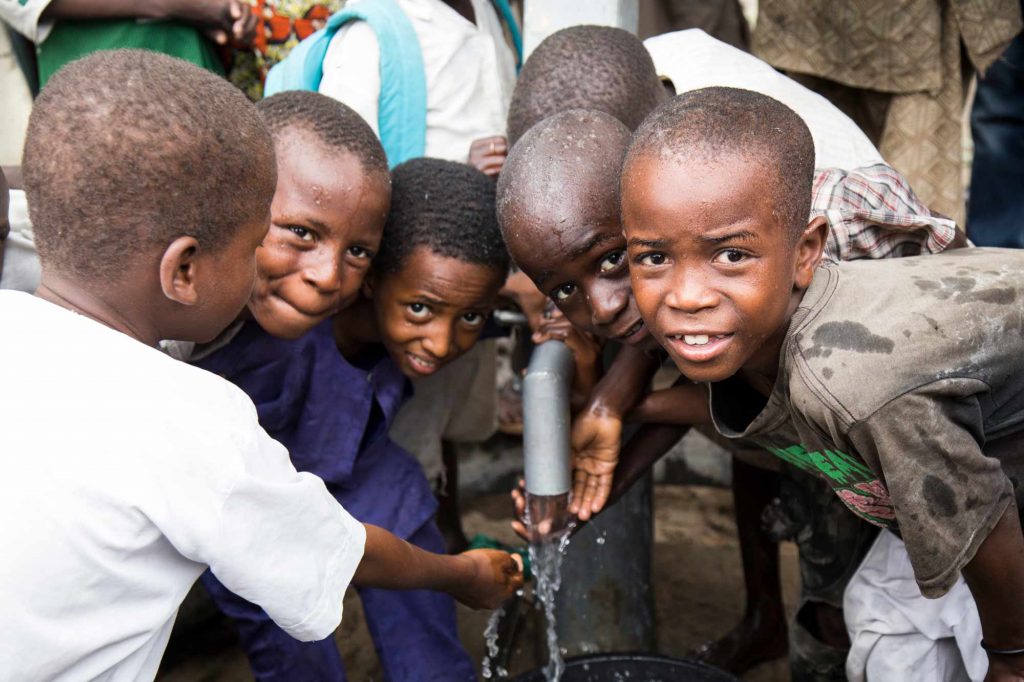
In Nigeria, International Medical Corps is working in the epicenter of the humanitarian crisis in the northeast triggered by ongoing conflict. Our goal is to improve access to safe drinking water, sanitation and hygiene for nearly 300,000 internally displaced persons (IDPs). We work in displacement camps and communities hosting large numbers of IDPs to create sources of safe drinking water by rehabilitating boreholes, using solar-powered submersible pumps and disinfecting water at the source and at the household level. This infrastructure is complemented by teams of community volunteers who educate families about the importance of personal hygiene for health, and teach them how to prevent potentially deadly waterborne diseases such as diarrhea and cholera.
In Yemen, amid civil war and frequent outbreaks of cholera, International Medical Corps provides improved water access to health facilities and communities through water trucking—delivering millions of liters to those who are frequently without adequate, clean water due to shortages of fuel needed for pumps. We also rehabilitate water-supply systems at the health facilities we support while providing training to their staff members. We have responded to outbreaks of cholera in five of the country’s most severely hit governorates—including the capital Sana’a and the cities of Aden, Ibb and Taizz. We have set up diarrhea treatment units and more than 20 oral rehydration points, and distributed hygiene kits, water purification tablets and IV fluids.
In Zimbabwe, we carried out an innovative project to increase water access to nearly 130,000 people in the Mashonaland central province, where accessible potable water was in short supply (in some villages, a single borehole served more than 600 households). Using local materials, we constructed bio-sand filters with layers of gravel and sand, through which water is poured for filtration.
In Gaza, we have installed desalination plants to treat water with salinity, producing thousands of liters of water per hour for various uses, including drinking water for our field hospitals there, and water for clinical uses. We also provide emergency water to the community via trucks. Searching for alternative water sources failed because the site was near the sea, requiring a high-capacity desalination plant to handle salinity above 30,000 ppm, which made it impossible to use the existing plant treating 7,000 ppm.
In 2025, International Medical Corps built or rehabilitated 350 sources of potable water benefiting more than 760,000 people in communities, camps, schools and health facilities.
We distributed nearly 148 million liters of potable water in 2025.
We helped form nearly 1,500 WASH and health committees in communities, camps, schools and informal settlements in 2025.