South Sudan
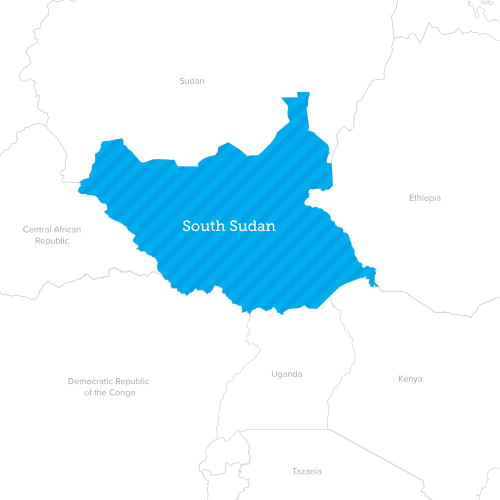
International Medical Corps has been working in South Sudan since the mid-1990s, nearly 20 years before a national referendum in 2011 led the southernmost states of Sudan to become an independent country later that same year.
Tensions within the new country broke into armed conflict in December 2013, claiming tens of thousands of lives before a fragile peace agreement took hold in the summer of 2015. Hostility continues to simmer, hampering efforts to improve public health standards in a country that has one of the world’s highest infant-mortality rates. The food-security situation remains desperate and the number of people at risk of starvation has increased. The potential for disease outbreaks is extremely high, with large numbers of displaced people and sharply reduced access to healthcare.
International Medical Corps currently operates in seven of the country’s 10 states, providing healthcare, nutrition, mental health and psychosocial support (MHPSS), capacity strengthening, services addressing violence against women and girls (VAWG), and water, sanitation and hygiene (WASH) support.
12.2 million
2.2 million
692 deaths
per 100,000 live births
The Challenges

Maternal Mortality
South Sudan has one of the highest maternal mortality rates in the world.

Healthcare Shortage
There are approximately 560 doctors serving more than 12 million people.

Hunger
An estimated 3.4 million women and children in South Sudan are at risk of acute malnutrition.
Our Response

Healthcare and Health Systems Support
International Medical Corps works with South Sudan’s Ministry of Health (MoH) and other partners to provide integrated health services and strengthen local healthcare systems across five states. To reach remote communities or populations isolated by natural disasters, we implement mobile healthcare services either as part of ongoing programs or in response to emergencies.
Our activities include:
- providing outpatient consultations for common communicable and noncommunicable diseases;
- providing integrated services in displacement settlements and remote areas, including facilities supported by the MoH;
- treating complications related to HIV/TB, including care for survivors of violence against women and girls;
- ensuring epidemic preparedness and response through established surveillance systems in supported health facilities;
- training healthcare workers in maternal and newborn health, the WHO’s Mental Health Gap Action Programme (MhGAP), integrated disease surveillance and response, HIV/TB, and infection prevention and control;
- promoting health education and services through community health and outreach workers; and
- strengthening national and county-level Ebola preparedness by enhancing infectious disease units, building frontline healthcare capacity, and supporting simulation exercises, mentorship and coordination to improve early detection, isolation, case management and rapid response.

Nutrition
An estimated 3.4 million women and children in South Sudan are at risk of acute malnutrition. International Medical Corps operates treatment centers for internally displaced persons, host communities and returnees in Canal Pigi, Fashoda, Malakal, Manyo, Panyijiar and Panyikang counties.
Our activities include:
- treatment and management of wasting;
- prevention of malnutrition through maternal, infant and young-child nutrition (MIYCN) programs;
- infection prevention and control;
- information management and learning, through support of population-based SMART surveys; and
- coordination and system strengthening, through support of cluster and sub-cluster groups.
Working closely with the MoH and other partners, International Medical Corps delivers community-based management of acute malnutrition through integrated inpatient and outpatient services, including MIYCN.

Maternal and Child Health
South Sudan has one of the world’s highest maternal mortality rates, with an estimated 692 deaths per 100,000 live births. The health system is rudimentary due to a limited number of qualified health workers, weak health infrastructure and limited access to quality maternal and newborn care. International Medical Corps implements services that focus on improving the health of women and their children.
International Medical Corps supports:
- maternal and child health, including antenatal and postnatal care, immunization, emergency obstetric care and referral support;
- specialized services for high-risk pregnancies and mental health needs;
- disease prevention and treatment, care for survivors of VAWG, integrated case management for HIV/AIDS; and
- capacity building, to reduce the gap in qualified health personnel.

Building Sustainable Local Health System Capacity
South Sudan faces a critical shortage of healthcare workers, with approximately 560 doctors serving more than 12 million people. Similar shortages exist among nurses, midwives and other paramedical staff, limiting access to essential services. To address this, we strengthen the health system by providing training programs for health workers. Since 2008, we have supported health workforce development, including co-managing midwifery schools aligned with International Confederation of Midwives standards. We currently co-manage the Health Sciences Institutes in Malakal and Wau, provide on-the-job and virtual training to strengthen Health Management Information Systems, and partner with the MoH, state ministries of health and county health departments to build sustainable healthcare capacity.

Violence Against Women and Girls
VAWG is an endemic problem in South Sudan, exacerbated by ongoing conflict and chronic displacement. Our programs are tailored to support and empower women and girls, as they are most affected by abuse and violence, and face risks during and after armed conflict and natural disasters. We strengthen core services for women and girls in Jonglei, Unity, Upper Nile and Western Bahr el Ghazal states, including survivor-centered case management, counseling and psychosocial support to enhance healing and recovery, as well as emergency cash to survivors to facilitate the case management process. We operate service points where women and girls can access psychosocial support, life-skills activities, referrals and community engagement. We also train local leaders and establish women’s management committees to strengthen ownership and sustainability.

Water, Sanitation and Hygiene
An estimated 6.8 million people require WASH services in South Sudan. We support internally displaced persons, host communities and returnees in Canal Pigi, Malakal and Renk by improving access to safe water, sanitation and hygiene while strengthening infection prevention and control.
Our activities include:
- implementing waste management in targeted health facilities, including handwashing stations, handwashing buckets and soap;
- adhering to infection prevention and control protocols;
- providing hygiene and sanitation messages; and
- constructing and rehabilitating gender-segregated latrines.

Mental Health and Psychosocial Support
Psychological problems, such as depression, anxiety, substance abuse and epilepsy (which is a neurological condition, but sometimes stigmatized in the same way as mental health conditions), are growing issues in South Sudan. Mental health services remain practically non-existent, due to a limited number of mental health professionals and inadequate supplies of psychotropic medication.
International Medical Corps provides evidence based MHPSS for people with mental, neurological and substance-use conditions in Jonglei and Upper Nile through awareness, psychoeducation, screening, case management, referrals, and policy support as co-chair of the national MHPSS Technical Working Group Partnerships International Medical Corps works closely with government institutions, donors, national and international NGOs and community organizations to maximize programmatic impact while strengthening local partner capacity and promoting sustainable interventions.
Partnerships
International Medical Corps works closely with government institutions, donors, national and international NGOs and community organizations to maximize programmatic impact while strengthening local partner capacity and promoting sustainable interventions.
Our Impact in 2025
“Midwifery Is Where Humankind Begins!”
South Sudan suffers from a drastic shortage of skilled birth attendants. Senior Midwife Supervisor Chuol Ker Yat Pan is one of a growing cohort of midwives helping to fill the gap.
READ MORE


Mirab Mojahed holds nutritional biscuits at an International Medical Corps screening in Malakal for people who escaped the war in Sudan.
International Medical Corps health workers conduct medical consultations in the flood-affected village of Dolieb.
Niema Mobarek Tieya and her family receive nutritional biscuits at an International Medical Corps screening in Malakal for people who escaped the war in Sudan.
Midwife Nyapin Chol Put conducts a prenatal checkup with a patient at the health clinic in Renk, South Sudan.
Clinical Officer Orach Adyiang examines a patient at an International Medical Corps clinic in Malakal.
A woman adds a magenta-colored hair extension while doing box braids—where individual braids are divided into square-shaped sections or boxes—for another woman at one of our women’s and girls’ safe spaces in Malakal.