Battling Ebola Outbreaks
International Medical Corps is responding to Ebola in the DRC and neighboring countries
On May 15, the World Health Organization reported an outbreak of the Bundibugyo strain of Ebola virus disease in Ituri province, Democratic Republic of the Congo (DRC). Since then, it has been reported in other provinces of the DRC, and there have been confirmed cases reported in Uganda. The Bundibugyo strain is not fully covered by vaccines developed that protect against the Zaire strain of Ebola—which was responsible for the 2014–2015 West Africa outbreak that killed more than 11,000 people—meaning it could be even more dangerous, since even vaccinated people are vulnerable.
The outbreak is especially concerning because it appears to have spread for several weeks before being recognized, meaning the current caseload may underestimate the true scale of transmission. It also is unfolding in a difficult context marked by conflict, population displacement and porous borders, increasing the risk of transmission of the disease.
International Medical Corps has already mobilized a rapid response team that includes trained medical staff, infection-control specialists, case management leads, and staff skilled in community engagement and supply-chain management. Drawing on our years of experience, we are working closely with the US Department of State, ministries of health and on-the-ground partners both within the DRC and in neighboring countries to procure critical supplies and provide the care and training needed to prepare for and fight this dangerous disease.
You can help stop the spread of Ebola. Donate now to help families and health workers affected by this outbreak.
Our Response
Fighting the Latest Outbreak of Ebola
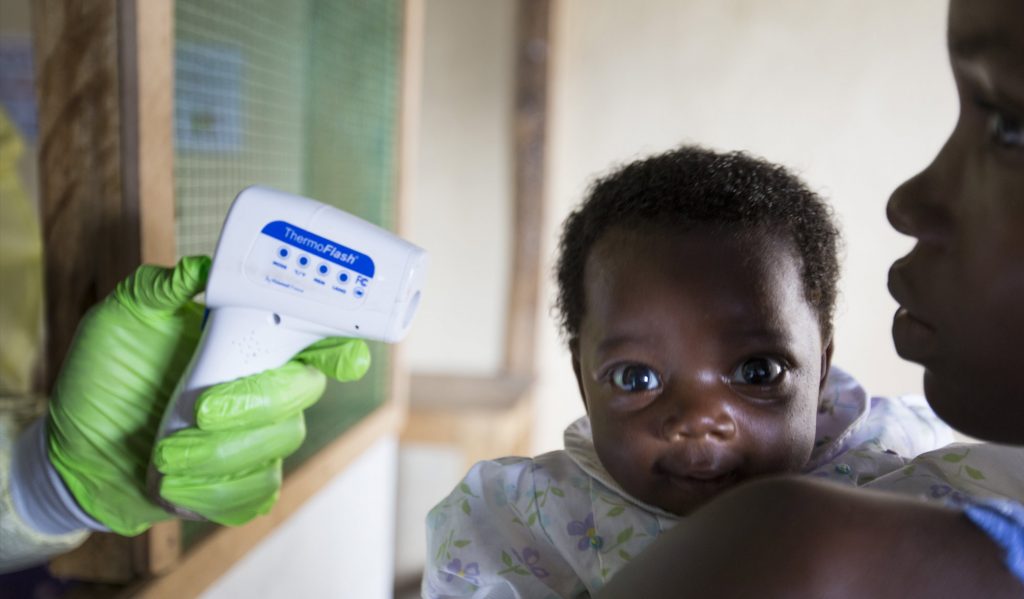
In response to the latest outbreak of Ebola, our teams are supporting national authorities and partners throughout the region in their response. Drawing on our extensive experience, we are focusing on interventions critical to breaking transmission chains, including:
- establishing screening and referral units (SRUs) to rapidly identify suspected cases, triage patients safely and minimize transmission in health facilities and communities;
- operating Ebola Treatment Units (ETUs) to provide isolation, clinical care and supportive treatment for confirmed cases;
- supporting infection prevention and control (IPC) measures, including training frontline health workers in how to treat this highly contagious disease and ensuring access to personal protective equipment (PPE), clean water and modern hygiene infrastructure; and
- strengthening community outreach and surveillance systems to educate affected communities, facilitate early referral and to build trust in affected communities.
Given the challenges in accessing remote and conflict-affected areas, and the potential for this dangerous disease to spread even further if not contained quickly, a timely and coordinated response will be essential to contain the outbreak and protect vulnerable populations.
We are closely coordinating with public health authorities and international partners in the DRC and surrounding countries, and will continue to adapt our response as the situation evolves. Your support is critical to enabling rapid deployment and sustained operations in these high-risk settings.
Our History of Fighting Ebola in the DRC
Since 2018, the DRC has frequently suffered from outbreaks of Ebola virus disease, a hemorrhagic fever with an alarmingly high mortality rate. Given our experience helping to lead the response to the 2014 Ebola outbreak in West Africa, International Medical Corps has been a key player in responding to these outbreaks.
We were called on in April 2018 to help the DRC fight an outbreak in Équateur province, in the country’s west. When that outbreak, the country’s ninth, was declared over in July of that year, a resurgence was close behind. On August 1, 2018, a new outbreak was declared in the country’s eastern provinces that would grow to become the second-largest Ebola outbreak ever, exceeded in size only by the 2014 outbreak in West Africa. After almost two years, thanks to the persistence and skill of our staff and other healthcare workers in the region, the end of the outbreak in this region was officially declared over on June 25, 2020. When the 10th outbreak in the east was officially declared over, 3,470 cases had been reported (including 3,324 confirmed and 153 probable cases), with 2,287 deaths and 1,171 survivors, according to DRC Ministry of Health data.
Celebration was muted, however: at the beginning of June of that year, the government announced a new outbreak—the country’s 11th—back in in Équateur province. As with other outbreaks, International Medical Corps deployed a rapid response team to support response efforts by the DRC Ministry of Health and the WHO, and ran Ebola Treatment Centers (ETCs) in the region. We also helped with treatment, IPC, screening, training and capacity-building. After this outbreak was officially declared over on November 18, 2020, we continued supporting regional health authorities during a 90-day period of heightened surveillance.
In the beginning of February 2021, another resurgence of the deadly disease occurred. Luckily, we were able to draw on previous work to battle this outbreak, the country’s 12th. As part of our efforts to expand local response capacity in the region, we built, opened and operated an ETC in Makeke (which we transitioned to a hospital for the community); operated Ebola Transit Centers in Beni and Mambassa; and operated an ETC in Mangina, the initial epicenter of the outbreak. In addition to providing treatment, vaccination and contact tracing during this last outbreak—officially declared over on May 3, 2021—International Medical Corps constructed nearly 100 screening-and-referral units throughout the region.
The country’s 13th outbreak, which emerged in North Kivu in early October 2021, was officially declared over in mid-December of that year. International Medical Corps provided case management services, training, and supplies and equipment to healthcare providers in the region, working closely with the Ministry of Health, local health officials and the international community. When several smaller outbreaks followed, we were able to help to contain them quickly.
In September 2025, an outbreak was declared in remote Kasai province. We rapidly deployed a response team to help with this outbreak by providing critical training and supplies to local health staff, coordinating closely with government efforts. Thanks to this quick response, the government was able to declare this outbreak—the country’s 16th—over by December of that year.
Responding to the Largest Ebola Outbreak in History
International Medical Corps has extensive experience and expertise in stopping the spread of Ebola, having responded in Guinea, Liberia, Sierra Leone, Mali and Guinea-Bissau in the wake of the 2014 West Africa Ebola epidemic, the world’s largest. We served as a key implementation partner for the World Health Organization, fielding a team of more than 1,500 and treating nearly 460 Ebola-positive patients in our five treatment centers. We helped host governments prevent further transmission of the virus, provided critical training to frontline health workers—and, importantly, stayed after the outbreak to continue to build local health systems and provide mental health and psychosocial counseling to those affected by the deadly disease. Find out more about our response during this dangerous time.
Frequently Asked Questions
-
What is happening with this recent Ebola outbreak?
On May 15, the World Health Organization and the Africa Center for Disease Control reported an outbreak of Ebola virus disease (EVD) in Ituri province, DRC. A highly contagious hemorrhagic fever, EVD halts the body’s blood-clotting system, causing blood to leak from blood vessels in an affected person’s body and leading to internal bleeding, inflammation and loss of fluid. Untreated, the body goes into shock from fluid loss. Death often follows.
Tests show that the outbreak is a result of the Bundibugyo strain of Ebola. Though slightly less fatal than the Zaire strain—which was most recently present in the DRC’s Kasai province in 2025, and which was responsible for the 2014–2016 West Africa Ebola outbreak that killed more than 11,000 people—the Bundibugyo strain is not fully covered by vaccines developed that protect against Ebola Zaire, meaning it could be even more dangerous, since those who have received the vaccine still vulnerable to contracting and dying from the virus.
-
What are the potential consequences of this Ebola outbreak?
Ituri, a small province in the northeast of the country that borders South Sudan and Uganda, is a mineral-rich region with a history of instability and violent conflict, usually driven by control over mines. Uganda has reported a confirmed case of Ebola, and the instability of Ituri province, combined with its proximity to neighboring countries, further increases the risk of transmission and cross-border infection.
Since the initial outbreak was detected, it has spread inside the DRC, with cases reported in Goma, the capital of North Kivu province, and as far away as Kinshasa, the country’s capital. There also have been confirmed cases and deaths reported in Uganda.
-
How is International Medical Corps responding to this Ebola outbreak?
International Medical Corps’ team in the DRC is conducting disease-treatment, surveillance and infection-prevention activities in the provinces, and providing training to healthcare staff. International Medical Corps also is distributing essential infection-prevention and hygiene supplies to health facilities—including handwashing stations, personal protective equipment (PPE), water basins, liquid soap and jerry cans—to ensure that trained staff have the resources they need to prevent the transmission of disease.
We are working in Uganda to respond through a partner in our LEARN initiative, and in at-risk countries like South Sudan we are working the the Ministry of Health on operational readiness, preparedness capacities and potential response considerations.
Support is urgently needed to strengthen International Medical Corps’ ability to respond to this Ebola outbreak during this time-sensitive period. Immediate procurement of appropriate supplies—such as PPE, IPC equipment, pharmaceuticals for patient support and WASH supplies—is needed, as well as support for key personnel throughout the region who are responding to the outbreak and conducting training.
-
Does International Medical Corps have experience with Ebola?
We have extensive experience and expertise in stopping the spread of Ebola, having responded in Guinea, Liberia, Sierra Leone, Mali and Guinea-Bissau in the wake of the 2014 West Africa Ebola epidemic, which killed thousands of people. With a team of more than 1,500 staff, we treated a total of nearly 460 Ebola-positive patients in our five treatment units, helped governments prevent further transmission of the virus, provided critical training to front-line health workers—and, importantly, stayed after the outbreak to continue to build local health systems as well as provide mental health and psychosocial counseling to those affected by the deadly disease. We also have been a leading actor in EVD response and management in the DRC since 2018, including multiple outbreaks between then and 2022, as well as the 2025 outbreak in Kasai province.
What We Know About Fighting Ebola
We talk with Dr. Adam Levine, the technical lead of International Medical Corps’ Ebola response, about the challenges facing those preparing to respond to the rapidly brewing emergency in Democratic Republic of Congo and the role the new vaccine plays in the response.
READ MOREResources
We Were There: Ebola in West Africa
After 28,000 cases and 11,000 deaths, the West Africa Ebola outbreak—the largest and deadliest in history—officially ended in late 2015 when Guinea was finally declared Ebola-free after two years of fighting the virus. One of the few international NGOs to treat patients afflicted with the virus at the source of the 2014 outbreak in West Africa, we worked in all three high-transmission countries—Guinea, Sierra Leone and Liberia—and cared for nearly 460 Ebola-positive patients through five Ebola treatment facilities.
Read more about our response