
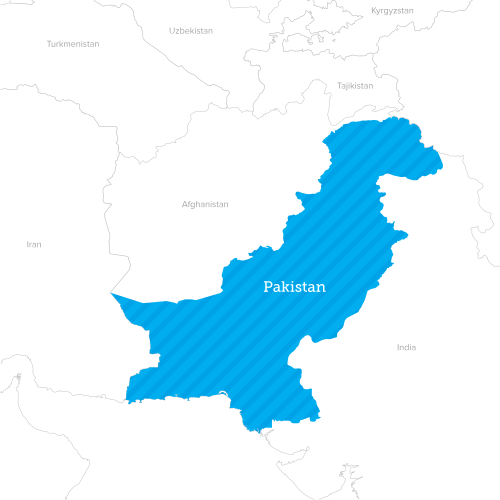
Pakistan
Pakistan is plagued by both ongoing instability and recurrent natural disasters that uproot families from their homes and destroy livelihoods. Military operations continue in the Federally Administered Tribal Areas (FATA), while floods and earthquakes are common.
International Medical Corps has worked in Pakistan since 1985, with our first program focusing on basic paramedical training to young Afghan refugees, who then returned home to treat neglected populations. This training was extended to Pakistanis living in volatile frontier areas in 1999 and we have since responded to major disasters throughout the country. When a massive earthquake struck the region in 2005, claiming more than 70,000 lives, our medical response teams were on the scene, treating survivors, within 12 hours.
252 million
68/73 years
male/female
155 deaths
per 1,000 live births
The Challenges
People in Crisis
An estimated 20.6 million people need humanitarian assistance

Natural Disasters
Pakistan is regularly hit by earthquakes and floods

Maternal Health
68% of births are attended by a skilled health worker
Our Response

Health Services and Support
Today, International Medical Corps works in several districts of Khyber Pakhtunkhwa, Punjab and Sindh provinces, providing the following services for Afghan refugees and vulnerable Pakistanis:
-
- primary healthcare and essential medicines, equipment and supplies;
- mental health and psychosocial support (MHPSS);
- prevention of and treatment of violence against women and girls (VAWG)
- community education and awareness-raising about health issues;
- capacity-strengthening of healthcare providers, including in the World Health Organization’s Mental Health Gap Action Programme (mhGAP);
- WASH-related health and hygiene services;
- skills training for women through the Women’s Economic Empowerment initiative;
- capacity-building training, including basic life support, psychological first aid (PFA), mhGAP, VAWG core concepts, WASH-related sessions, food security and livelihoods;
- digital literacy and sustainable livelihoods programs to help entrepreneurs manage and grow online businesses;
- youth empowerment programs, in which participants implement small-scale, community-driven projects;
- women- and girls-friendly spaces (WGFS) where we provide a safe space for support services, awareness sessions and community engagement; and
- helplines for survivors of VAWG.
In 2025, our teams in Pakistan provided services to 739,304 people, including healthcare services, mental health care, VAWG and mental health case management, VAWG prevention and response training, awareness-raising sessions on VAWG, MHPSS, health and hygiene-related topics, and training in WASH-related interventions and in PFA and mental health case management, including mhGAP.
International Medical Corps also successfully implemented a project to rehabilitate and solarize Expanded Program on Immunizations (EPI) centers in Shaheed Benazir Abad, one of the worst flood-affected districts in Sindh province. We rehabilitated 10 EPI centers, which now provide about 19,300 children per year with uninterrupted immunization services. By solarizing the centers, we have ensured a steady supply of power and mitigated carbon emissions.

Water, Sanitation and Hygiene
In 2025, International Medical Corps provided comprehensive WASH services to 287,332 people. Our teams also trained more teachers, health workers and community leaders in proper WASH procedures, and provided hygiene awareness sessions to several communities. In response to devastating flooding in the country, International Medical Corps conducted 203 hygiene promotion sessions in Buner and Shangla districts, reaching 13,974 people with WASH-related messages. To improve access to safe drinking water, our WASH team has distributed 1,800 water storage kits and 117,000 water-purification units.

Mobile Medical Units
In 2025, Pakistan experienced devastating floods that caused widespread loss of life, displacement and destruction of critical infrastructure and livelihoods across multiple provinces. As part of our emergency response, our mobile medical teams delivered more than 34,700 primary and emergency healthcare consultations through camps and static health facilities, restoring access to essential, lifesaving services for flood-affected families across Buner and Shangla districts. Our MHPSS team conducted hundreds of individual and group counseling sessions, providing psychosocial support to 6,830 people. We also distributed 1,300 winter kits to families, including 600 kits in Buner, 600 in Shangla and 100 in Alipur, Muzaffargarh (Punjab).
Mobile Medical Teams Bring Hope to Flood Survivors
International Medical Corps is delivering urgent medical, mental health, clean water and modern hygiene services to flood-affected communities in Pakistan.
READ MOREOur Impact


Manhoor, 6, was suffering from acute bacterial pharyngitis. Here, she holds medicine she received from International Medical Corps.
Dr. Shahista Ibrar, Women’s Medical Officer with International Medical Corps, meets with 10-year-old Alemat at a hospital in Shangla district.
Youth Empowerment Program participants meet at a local bazaar to discuss their community service project.
Faiz Ullah, MHPSS Roving Social Worker with International Medical Corps, visits Youth Empowerment Program participant Zahid (left) at his samosa and chaat stall in the local bazaar.
Youth Empowerment Program participants install tanks that store clean, safe water for their community.
Dr. Shahab Uddin, Medical Officer with International Medical Corps, examines Bakhti Hillal, who came to our health clinic because he was suffering from a respiratory-tract infection.