Midwife Training
Women's & Children's Health
International Medical Corps works tirelessly to save the lives of mothers and children, who are often the most vulnerable in the midst of war, disaster and outbreaks of disease. Every year, nearly an estimated 300,000 women and 3 million newborns die from complications during pregnancy and childbirth or from neonatal complications. More than 90% of these deaths occur in low- and middle-income countries, and most could be prevented with low-tech, low-cost care in the form of a skilled midwife—a profession that is tragically under-represented across the world.
Studies show that trained midwives could provide the majority of essential care needed for women and newborns. Midwives can identify complications around pregnancy and childbirth early, provide first-line emergency obstetric and newborn care, and, when needed, refer cases to appropriate higher-level care. Adequately trained midwives can also provide prenatal care, testing and counseling for sexually transmitted infections, assistance at delivery, postpartum care, newborn care and breastfeeding support. This includes care for survivors of violence against women and girls.
To help fill a massive global gap in maternal healthcare, International Medical Corps runs robust midwife training programs in countries that have the highest maternal mortality rates in the world, including Afghanistan, the Central African Republic (CAR) and South Sudan.
South Sudan
War-torn South Sudan has one of the highest maternal mortality rates in the world. Each mother in South Sudan has a one in seven chance of dying in childbirth during her lifetime. Meanwhile, 10% of South Sudanese children die from common, often preventable, illnesses before they reach their fifth birthday.
Though we provide comprehensive maternal and newborn healthcare—including safe delivery and emergency obstetric and newborn care—in all of our primary health clinics, it remains imperative to strengthen South Sudan’s healthcare worker capacity and geographic distribution. Decades of conflict and insecurity have decimated South Sudan’s workforce, leaving much of the population without access to basic care. To ensure that mothers and children throughout the country receive the lifesaving services they need, International Medical Corps trains midwives and nurses who then take their skills and knowledge back into underserved communities.
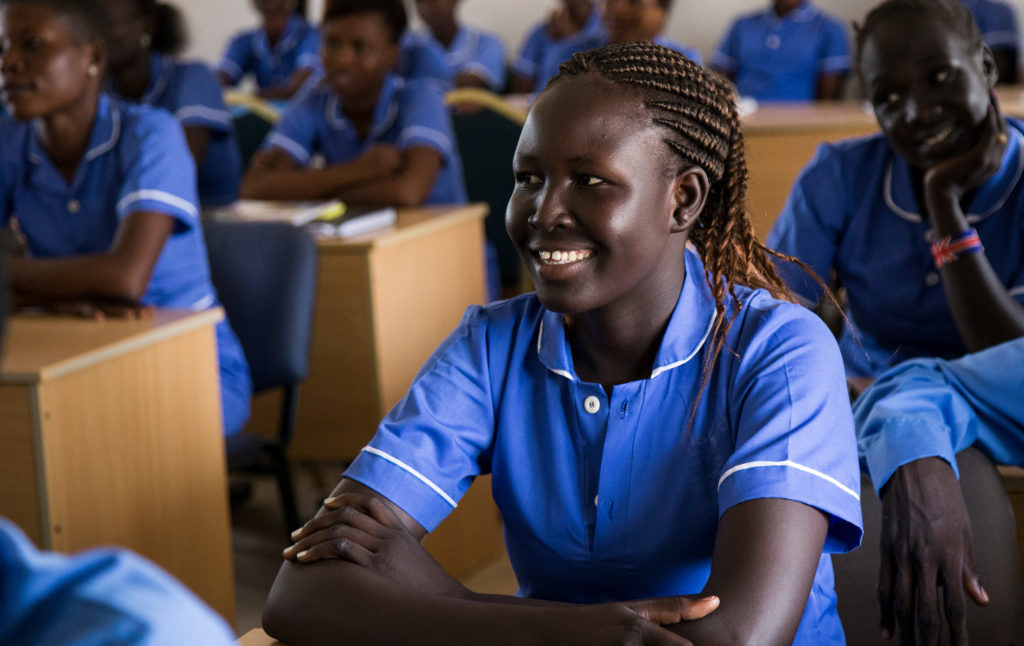
We previously supported midwife training at the National Training Institute at Kajo Keji, the National Midwifery School in Wau and the Juba College of Nursing and Midwifery. Our offerings included classroom programs, skills-building in laboratory and clinical settings, and continuous professional development and mentorship. From 2012 to 2024, International Medical Corps graduated 670 midwives and nurses, many of whom now work for International Medical Corps, the Ministry of Health and other NGOs within the country. We provide support for on-the-job training to midwives and other healthcare workers at Malakal Teaching Hospital and at six International Medical Corps-supported health facilities across Malakal.
In South Sudan, International Medical Corps has helped increase the number of midwives by more than 2,000%.
Meet the courageous and determined midwives of South Sudan.
Central African Republic
As CAR struggles to emerge from decades of conflict, its government has identified maternal and newborn health as a top national priority, due to the ways it will help other sectors of society, including improved numbers of skilled birth attendants, economic growth, family nutrition and education.
To address CAR’s extremely high maternal mortality rate, International Medical Corps established L’Ecole de Formation des Assistantes Accoucheuses de Bria, a new school for auxiliary midwifery. Strategically located in Bria, in east-central CAR, the school will serve the Haute-Kotto, Haut-Mbomou, Mbomou and Vakaga prefectures. The students are recruited from current employees of Ministry of Public Health-supported health centers and clinics around Bria. The two-year auxiliary midwife certification program will qualify them to provide a range of nursing and midwifery functions when they return to their health centers and clinics.
International Medical Corps is working closely with Bangui University of Health Sciences to ensure that the new program complies with standards and remains sustainable at the national level well into the future.