Somalia
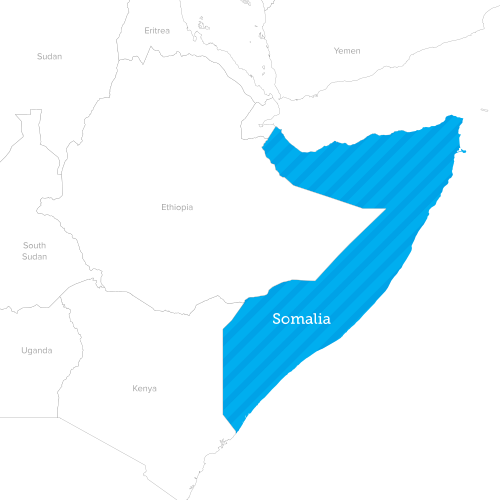
In Somalia, nearly 4 million people are internally displaced due to conflict and weather-related conditions. Droughts and floods continue to trigger food insecurity and disease outbreaks, including acute watery diarrhea, cholera and acute malnutrition. Of the 6.9 million people requiring humanitarian assistance, 4.3 million are experiencing acute food insecurity.
International Medical Corps has worked in Somalia for more than 30 years, creating and maintaining robust working relationships with local communities and authorities to bring relief to those in need. We provide emergency relief and essential services to crisis-affected populations through programs in health, nutrition, mental health and psychosocial support (MHPSS), protection, and water, sanitation and hygiene (WASH).
18 million
56/62 years
male/female
101.7 deaths
per 1,000 live births
The Challenges

Limited Healthcare
Healthcare services in Somalia remain inconsistent and limited.

Malnutrition
An estimated 1.84 million children suffer from malnutrition.

Displaced People
Nearly 4 million people are internally displaced due to conflict and weather-related conditions.
Our Response

Health
In Somalia’s conflict-affected areas, access to basic healthcare remains a challenge. International Medical Corps supports health facilities—including hospitals, healthcare centers and integrated community case management (ICCM+) sites— serving remote communities, urban populations and internally displaced persons (IDPs). In 2025, our health services reached more than 445,000 people across several states, including Benadir, Galmudug, Hirshabelle and Southwest.
Our healthcare services include:
- outpatient and inpatient treatment for communicable and noncommunicable diseases and MHPSS;
- routine immunization for children under 5 and women of childbearing age;
- basic and comprehensive emergency obstetric and neonatal care (BEmONC and CEmONC);
- antenatal and postnatal care, including nutrition screening and referrals for pregnant and lactating women (PLW);
- integrated ICCM+ and training community health workers to diagnose and treat malaria, diarrhea and pneumonia;
- care for survivors of violence against women and girls, including psychosocial support;
- health education, promotion and community awareness;
- emergency response to disease outbreaks, including acute watery diarrhea and measles; and
- referral services, infection prevention and control (IPC), disease surveillance, health reporting to Somalia’s Ministry of Health (MoH) and UN Health Cluster, and innovative monitoring approaches to reduce morbidity and mortality.

Nutrition
Somalia has long struggled with chronic food insecurity, worsened by poor agricultural practices and frequent natural disasters. In 2026, an estimated 1.84 million children under 5 are projected to suffer from acute malnutrition, including approximately 483,000 with severe acute malnutrition requiring lifesaving treatment.
To address this crisis, International Medical Corps implements comprehensive nutrition programs across dozens of facilities in Galmudug, Hirshabelle and Southwest states, targeting children under 5 and pregnant and lactating women. Our programs combine quality nutrition services with health system strengthening and behavior change interventions to reduce child and maternal morbidity and mortality.
Our nutrition services include:
- growth monitoring and nutrition screening;
- inpatient and outpatient treatment of acute malnutrition;
- preventive nutrition services, including blanket supplementary feeding for children and PLW;
- maternal, infant and young-child nutrition (MIYCN) counseling;
- micronutrient supplementation and deworming;
- health and nutrition education;
- training health workers on integrated management of acute malnutrition, MIYCN and ICCM+; and
- community-based interventions, including the Family mid-upper arm circumference (MUAC) approach, peer support groups, cooking demonstrations, community dialogue and sensitization on infant and young-child feeding.

Water, Sanitation and Hygiene
Somalia faces severe WASH challenges caused by inadequate sanitation, poor hygiene practices, limited access to safe drinking water, prolonged drought and recurrent flooding. International Medical Corps delivers emergency WASH programs that improve access to safe water and sanitation through community-led approaches and behavior change. We support WASH infrastructure in health facilities, displacement camps and communities by drilling boreholes, extending water pipelines, installing rainwater harvesting systems, providing water storage, and rehabilitating shallow wells with solar-powered pumps.
Our interventions also promote hygiene awareness, solid waste management and infection prevention and control while distributing hygiene kits to improve living conditions. We strengthen sustainability by training facility staff and community water management committees in operation and maintenance. International Medical Corps serves as the WASH Cluster focal point in Mudug region and actively contributes to technical working groups and the WASH Cluster Strategic Review Committee.

Mental Health and Psychosocial Support
Conflict, displacement and weather-related disasters have significantly increased mental health needs in Somalia, with approximately one in five people expected to experience conditions such as anxiety, depression or post-traumatic stress disorder. International Medical Corps integrates culturally appropriate MHPSS services into primary healthcare while supporting national priorities to strengthen community resilience.
Our programs provide:
- integrated mental health services;
- training on MHPSS;
- counseling, psychosocial support and group sessions;
- and community awareness campaigns promoting access to mental health services.
Protection
International Medical Corps delivers integrated protection services for women, girls and other populations affected by conflict, displacement, violence and weather-related disasters. In the first quarter of 2026, more than 511,000 people were displaced, 93% due to drought. Women and children represented approximately 85% of those displaced, increasing risks of violence, exploitation, abuse and family separation.
Our survivor-centered programs promote safety, dignity and resilience while strengthening community protection systems. We currently operate in Galgaduud, Galkayo and Hobyo districts in Mudug region, managing three women’s and girls’ safe spaces (WGSSs) that provide confidential case management, psychosocial support and life-skills training. Participants receive vocational training in tailoring, tie-and-dye, henna decoration and makeup artistry to strengthen resilience and economic self-reliance.
Community outreach teams engage leaders and community members to prevent violence, promote positive social norms and strengthen community ownership of protection initiatives. We also distribute dignity kits containing menstrual hygiene and personal care items to safeguard the health and dignity of women and girls affected by crises.

Capacity Building
International Medical Corps has extensive experience strengthening Somalia’s health workforce through training, mentoring and technical support delivered in collaboration with Somalia’s MoH. All training follows the Somali national curriculum and internationally recognized standards, including WHO guidelines.
Our training areas include:
- medical and surgical case management for adults and children;
- BEmONC and CEmONC;
- IPC, MHPSS and MICYN;
- community health programming;
- integrated management of acute malnutrition;
- services that address violence against women and girls;
- community-led total sanitation; and
- mass casualty management and basic emergency care.
Through partnerships with health facility committees, mother-to-mother support groups and community organizations, International Medical Corps strengthens local capacity to address public health priorities. We also train female health workers and community health workers to deliver health, nutrition and hygiene education, enabling communities to prevent illness and respond independently to health challenges.
Our Impact in 2025
Caring for Children and Displaced Families in Somalia
International Medical Corps has provided lifesaving care to millions of families across the country, despite overwhelming challenges.
READ MORE


Two-year-old Naima Sheikh Mahad Ali Salad receives treatment for severe malnutrition with complications at an International Medical Corps stabilization center.
An International Medical Corps healthcare worker attends patients at an IDP camp in Baidoa.
Community members and International Medical Corps staff celebrate a newly installed borehole that provides access to clean, safe water.
Sahro Hersi, 27, holds her son outside Galkayo South Hospital.
Maryan Yussuf is fed by her mother after being admitted to the Jowhar Regional Hospital due to malnutrition.
An International Medical Corps health worker takes the mid-upper arm circumference measurement of Mohamed, a child suffering from malnutrition, while he sits in his mother’s lap.