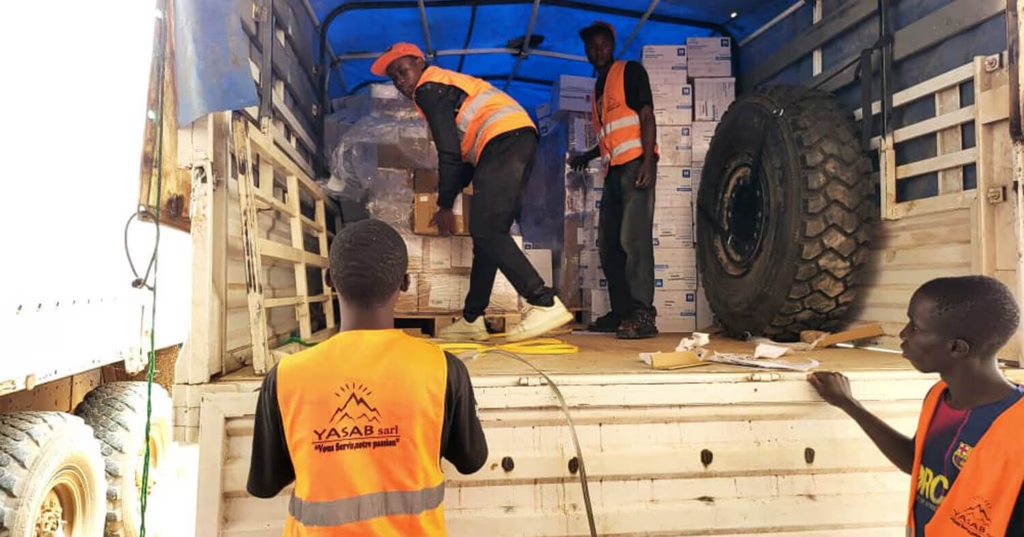
In the Democratic Republic of the Congo, International Medical Corps is continuing to respond to an Ebola epidemic that’s already the second-largest outbreak in recorded history. A contagious-disease response of such enormous scale calls for an equally massive amount of personal protective equipment (PPE). Fortunately, our Procurement team is on the job.
Because International Medical Corps has responded to many Ebola outbreaks across Africa, we already had a strategy in place for sourcing materials. We know what kinds of PPE we need—aprons, boots, gloves, gowns, coveralls, goggles, masks—and have prequalified vendors in place. Because of the dangers of Ebola and the size of this outbreak, we are ordering PPE in mass quantities—for instance, we have procured 3 million pairs of gloves, 150,000 pairs of coveralls and 5,000 pairs of boots so far. At the same time, we are also procuring pharmaceuticals and medical consumables from prequalified vendors in Europe and Dubai.
Once the DRC team determines what products they need and in what quantity, they submit a purchase requisition to Global Procurement, which has run into challenges: because of the size of the Ebola response and the number of organizations working on the response, some vendors are running into stockouts. This means that a purchase order might be divided into many shipments.
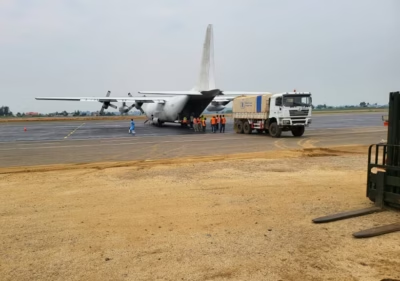
We make sure that everything that’s in stock is shipped to us right away. As soon as other items come back into stock, we try to move them into the DRC as quickly as possible. Our flight partners—including Airlink, Flexport and Hulo—have volunteered to fly our cargo into the nearest large airports, which are in Uganda and Rwanda. Shipments to Entebbe (in Uganda) ultimately wind up in the cities of Beni and Butembo, in North Kivu province, and in Bunia, in Ituri province. Shipments into Kigali (in Rwanda) go to our office in Goma, in North Kivu province. From there, they on to our warehouses in Goma or Bunia, or to Ebola treatment centers (ETCs) in other parts of the DRC.
Once supplies arrive in the DRC, Logistics Coordinator Magloire Ntwali takes over. He coordinates the receipt of these shipments, ensures that they have the proper documentation, fast-tracks customs processes and organizes onward transport to our warehouses, as well as distribution to the Ebola-affected areas that need them the most. He also oversees inventory management and works closely with the program teams to make sure the supplies are delivered safely, securely and on time to treatment facilities. This requires him to be in constant contact with suppliers, transporters, warehouse teams, health staff and local authorities to make sure that shipments make it to their destination—despite security challenges, administrative requirements and difficult road conditions.
“No matter how, we get it there,” says Anne Rollin Bakovic, Senior Officer, Global Procurement.
Magloire deployed from Goma to Bunia at the beginning of the response to lead the rapid-response team there, which led to International Medical Corps obtaining approval to manage the ETC at Bunia General Hospital, which is at the epicenter of the epidemic.
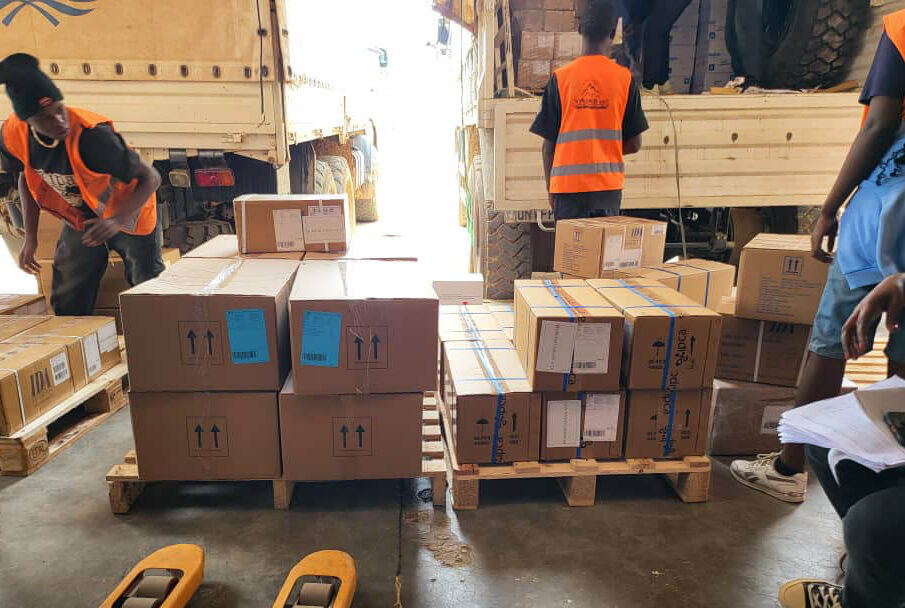
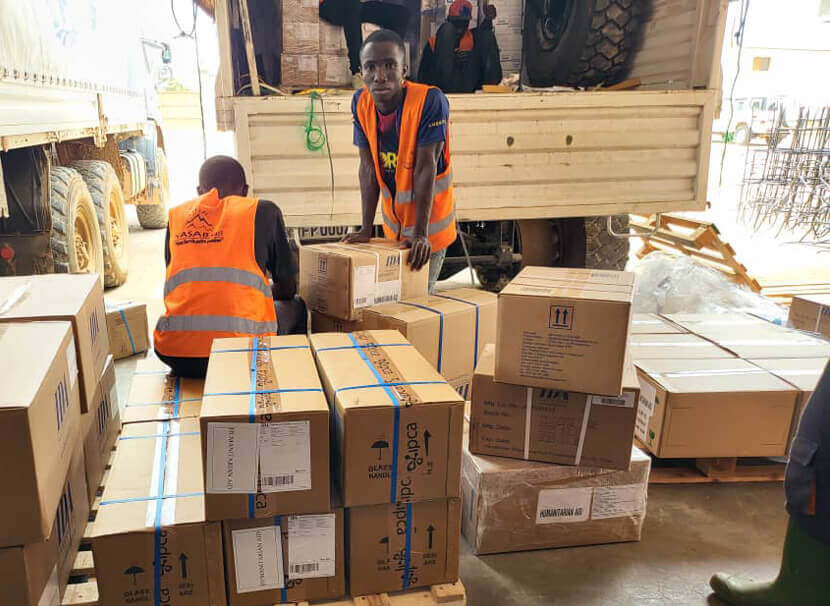
Procuring Construction Materials
In addition to PPE, Magloire and our DRC team have had to procure construction materials to build the facilities needed to isolate and treat patients. Since the Ebola outbreak was declared in May, we have opened four ETCs and seven Ebola transit centers, with plans to construct more.
Most of the supplies we need to build these centers are available from local vendors within the community. As with PPE, demand for these items has been high, which has led us to also visit neighboring villages to procure needed materials.
The Procurement team’s tireless work has enabled our teams to construct critical infrastructure in short order.
“ETCs usually take 21 days to construct, but the first ETC in Bunia was completed in less than two weeks,” Magloire says. “Through careful coordination and effective supply-chain management, we have been able to mobilize resources quickly and support the construction of critical treatment infrastructure within very short timeframes.”